 Strength Pace
Beta Looking for 20 testers
How strong. How fast.
Log your lifting and your food in one app, and see how what you eat fuels your strength.
Strength Pace is in beta, and I'm looking for 20 lifters to test it while I finalize the algorithm, and hopefully long after. Tell me where the numbers look right, where they look wrong, and what's missing.
Reach me any time at strengthpace@gmail.com or send a message.
Beta · Free while we test
 Or scan with your phone's camera
Already log in Hevy, Strong or MacroFactor? Import your history. With enough of it, your Index can open the day you import.
Scored on your phone. Sign in with Apple or Google to back up and sync, or use it without an account.
Food and strength, one app
See how your food fuels your strength.
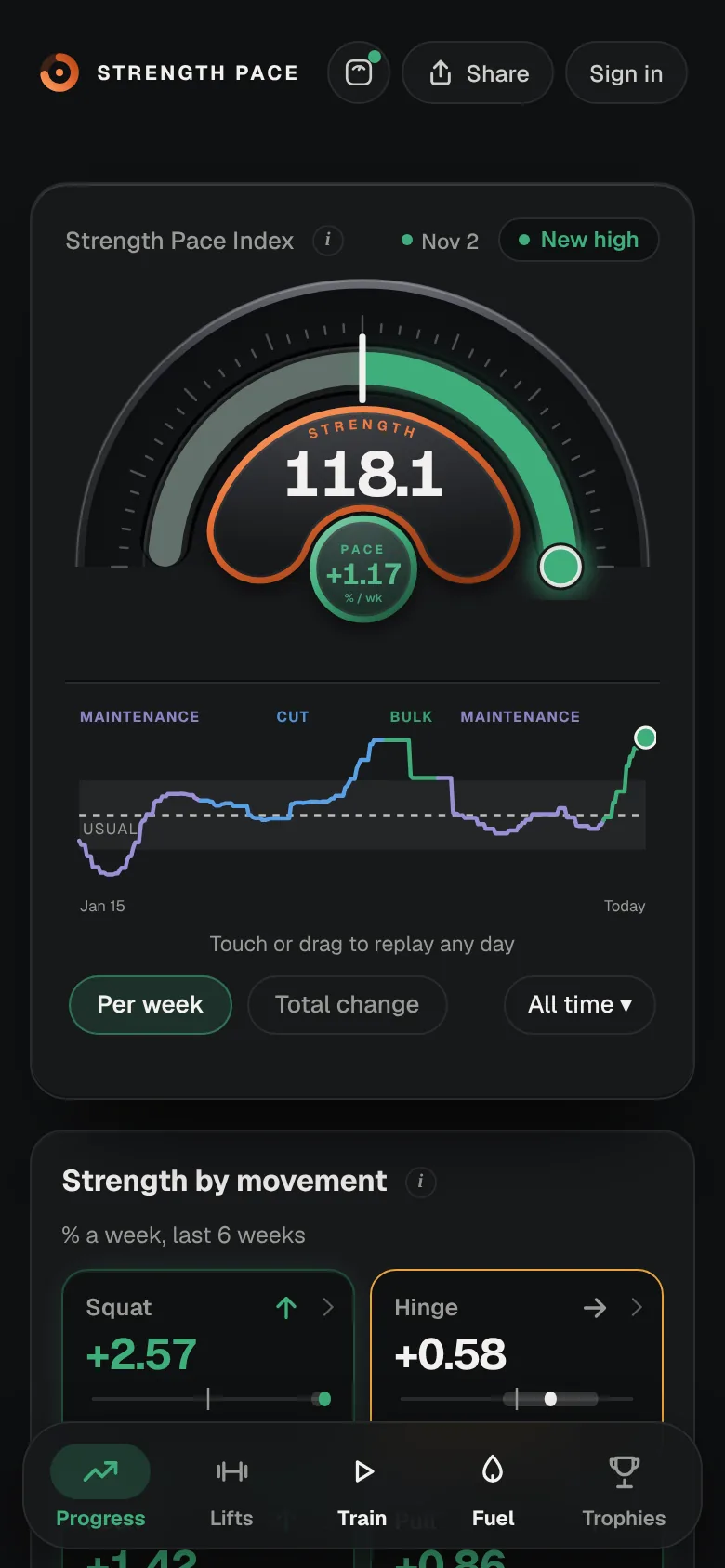
Log your food and weigh in, and your cut, maintenance and bulk are drawn under your weekly pace. Once you unlock your Index, watch how fuel and progressive overload move your strength through every phase.
The full dial, after months of training.
- Full body. Your Index counts squat, hinge, push and pull.
- Your own range. The app learns how much your lifts normally swing from one session to the next, so a real change stands out from a good or bad day.
- Every adaptation. Strength comes from neural and muscular adaptation. Your Index tracks the result.
One lifter's data through Nov 2, 2026, scored by the app's current method.
Built for the long run
How strong are you? How fast are you getting stronger?
Every workout and every food log builds your own answer to those two questions.
From the start, Strength Pace is a fast, functional log for your workouts and your food. Every set comes with its target from last time. Meals go in by search, barcode scan, or one typed line.
What you're building toward: how strong you are, how fast you're getting stronger, and how your strength moves through each cut, maintenance and bulk. Stalled lifts show up with the next target to try. A refined algorithm, backtested on real training data, turns your sets into that read, and it gets more precise the longer you log.
Accuracy takes time. That's the point.
Illustration: what the Progress page does the moment your Index opens. Values are an example.
- Day 1Start logging.Every set starts the read.
- About a month inStrength unlocks.Two movements open your Index. Train one lift five times in each, and your Strength number opens at 100, measured against your own first sessions, and each movement you add makes it cover more of your training. It nudges you toward full-body training: the Index counts squat, hinge, push and pull.
- About two months inYour early pace.Six weeks after your first workout, you see how fast your strength is moving each week.
- Six to eight months inThe full dial.Your pace is ranked against your own usual, so you know when you're ahead of your normal. The pace graph arrives with it, with your cut, maintenance and bulk named on the line.
- A year or moreEvery phase.Come back to a phase you've trained in before, and your pace is measured against that phase. Now you can try to outpace yourself in every phase.
Already put in the work? Import your training log. The timeline starts where your history does, so with enough of it the dial can open the day you import.
Timing from one lifter's log and simulated lifters training three times a week. Yours depends on how often you train and when your phases change. Weighted lifts are scored; cardio, bodyweight and reps-only moves are tracked, not scored.
Train
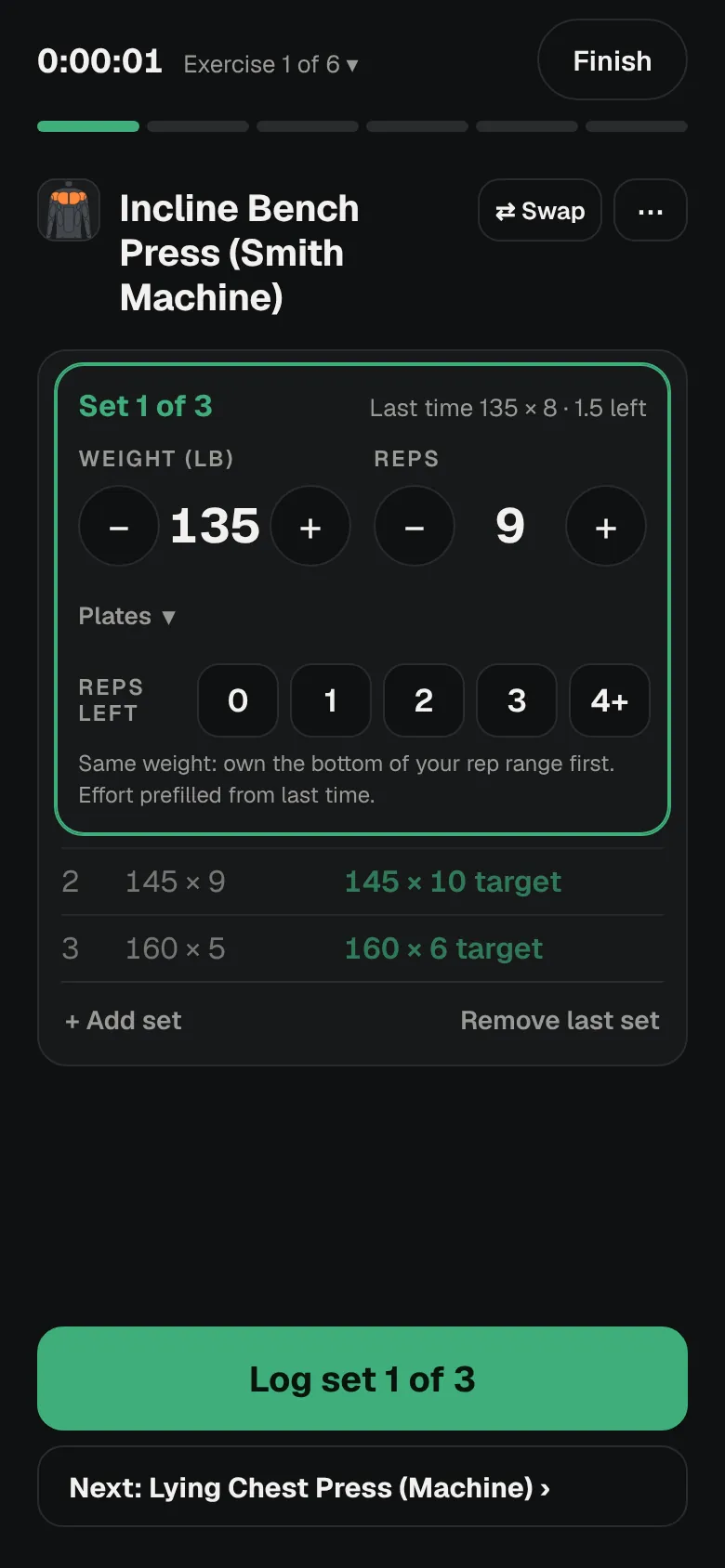
Progressive overload, built in.
Every set has its target from your last session. A plate calculator shows what to load on each side. Weekly set guardrails per muscle. Missed a day? Log a past workout on its date. Log in pounds or kilograms; pick at setup, or keep a kilogram import in kilograms.
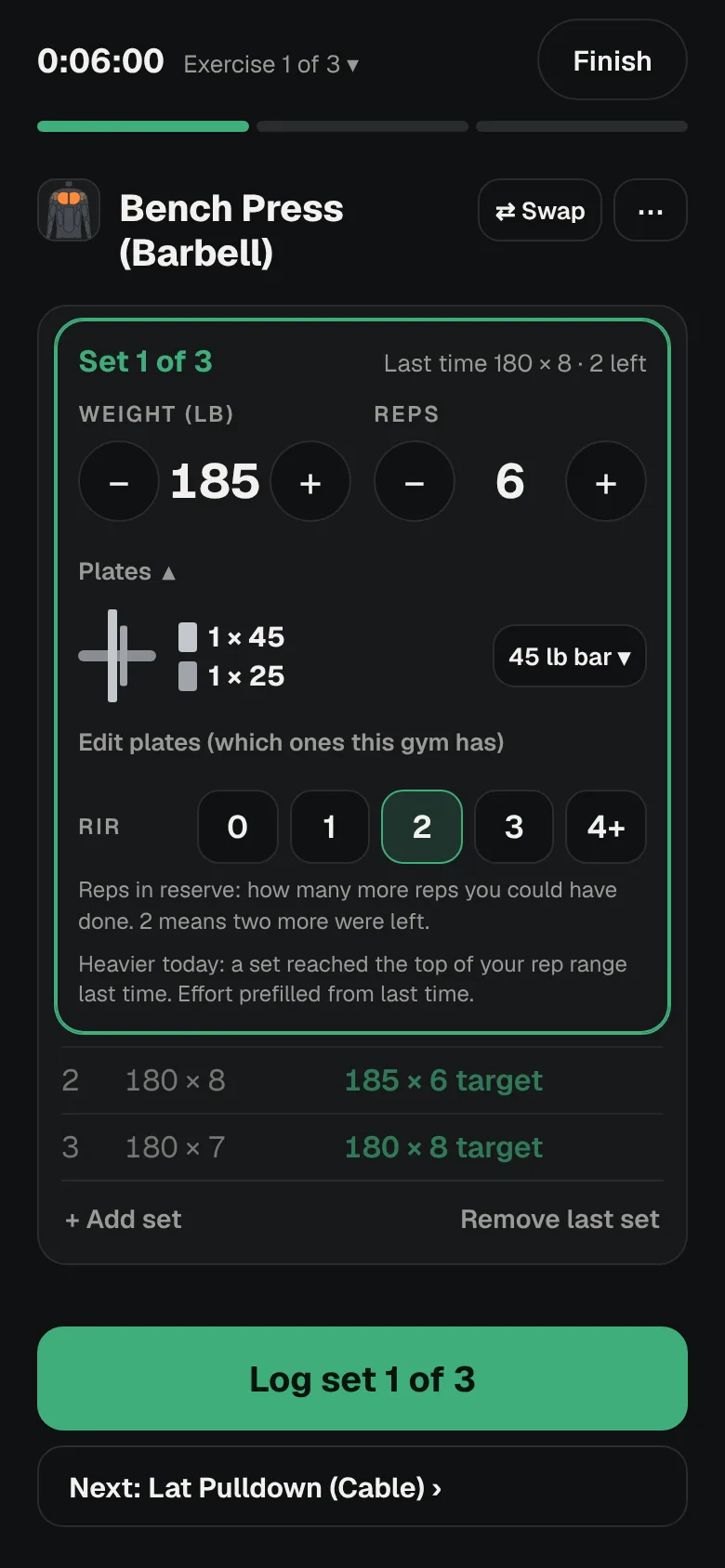
Sample workout.
Fuel
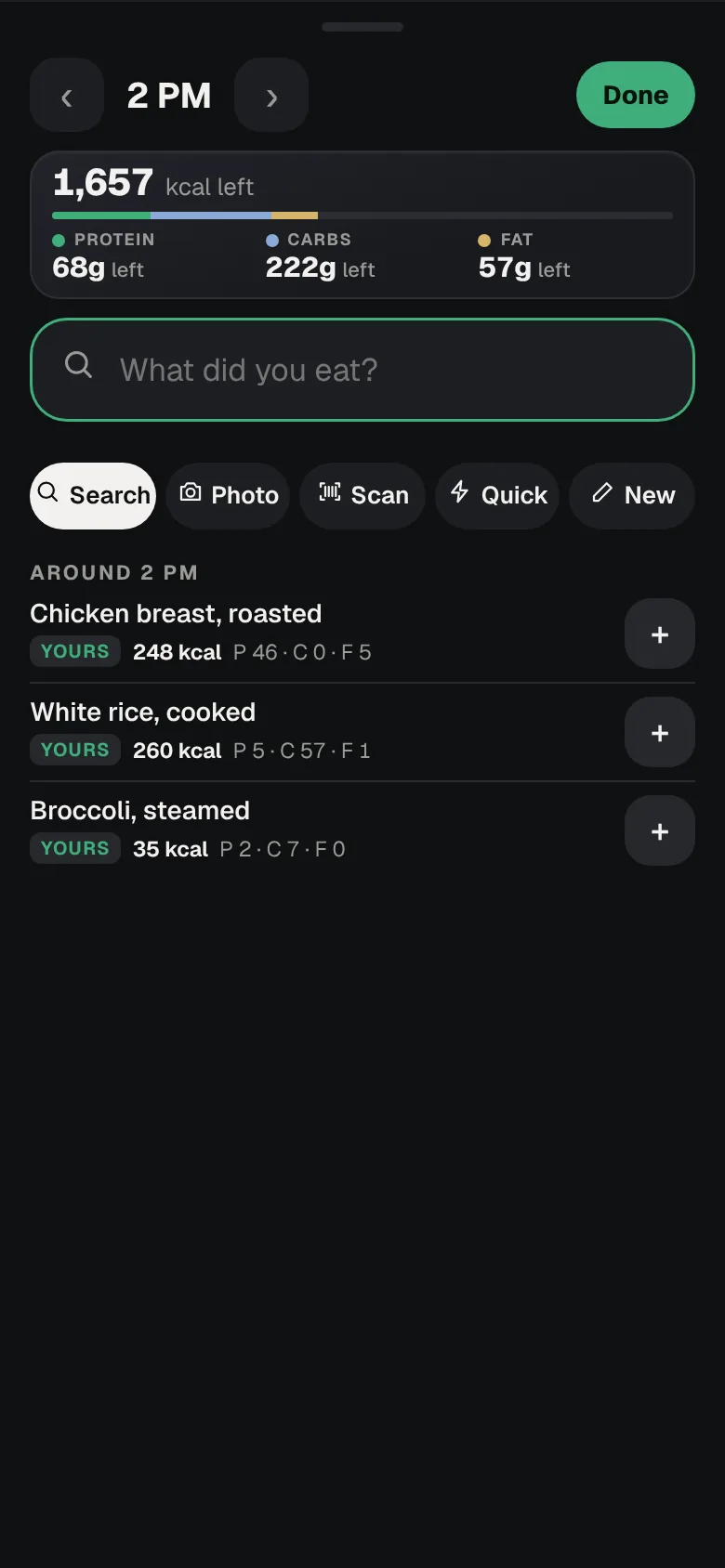
Food logging in the same app as your training.
Search 13,344 USDA foods that live on your phone, so they work offline. Packaged foods, from more than 428,000 products, and barcode scans need a connection. Or type a whole meal on one line and each food is drafted with an amount for you to check.
USDA values, as the app drafts them. Protein in green.
Fuel
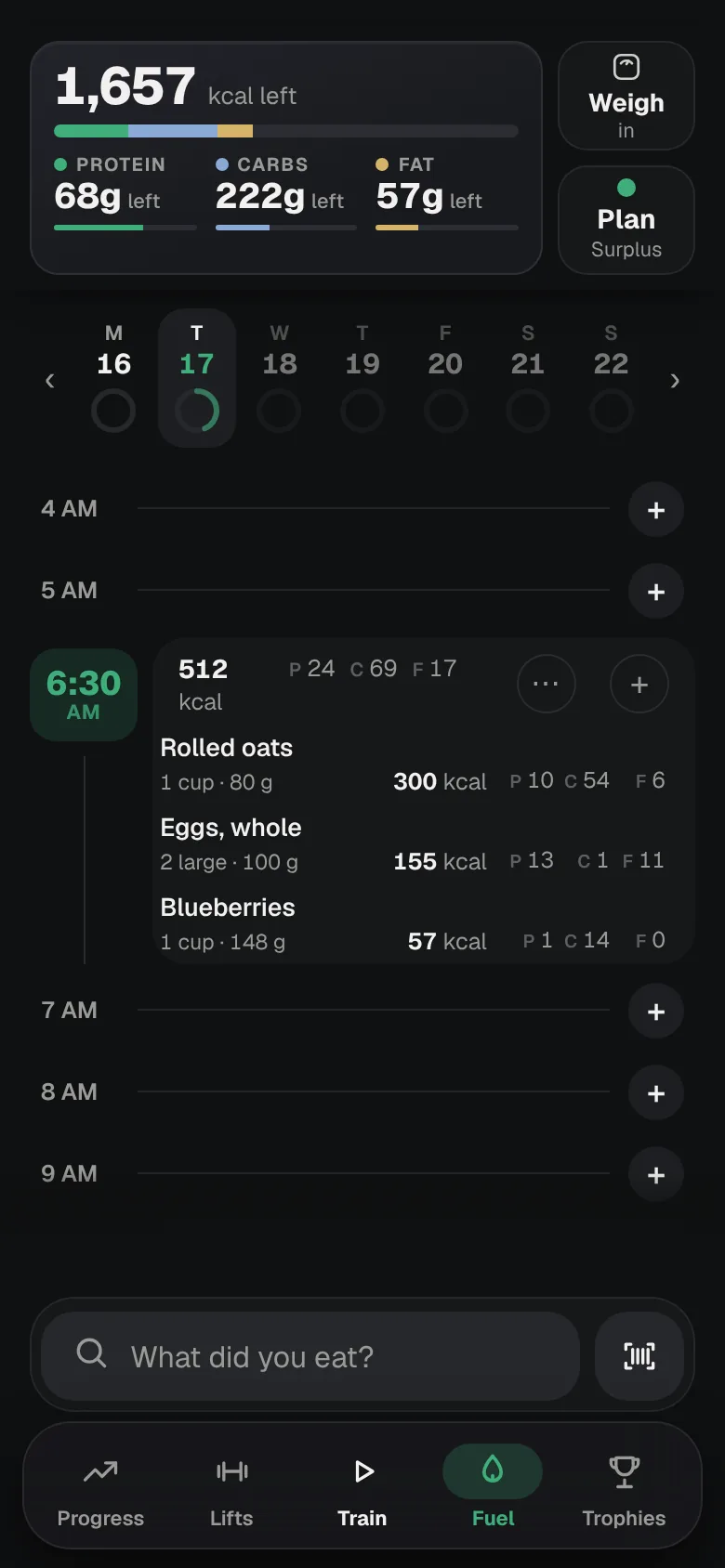
Your day at a glance.
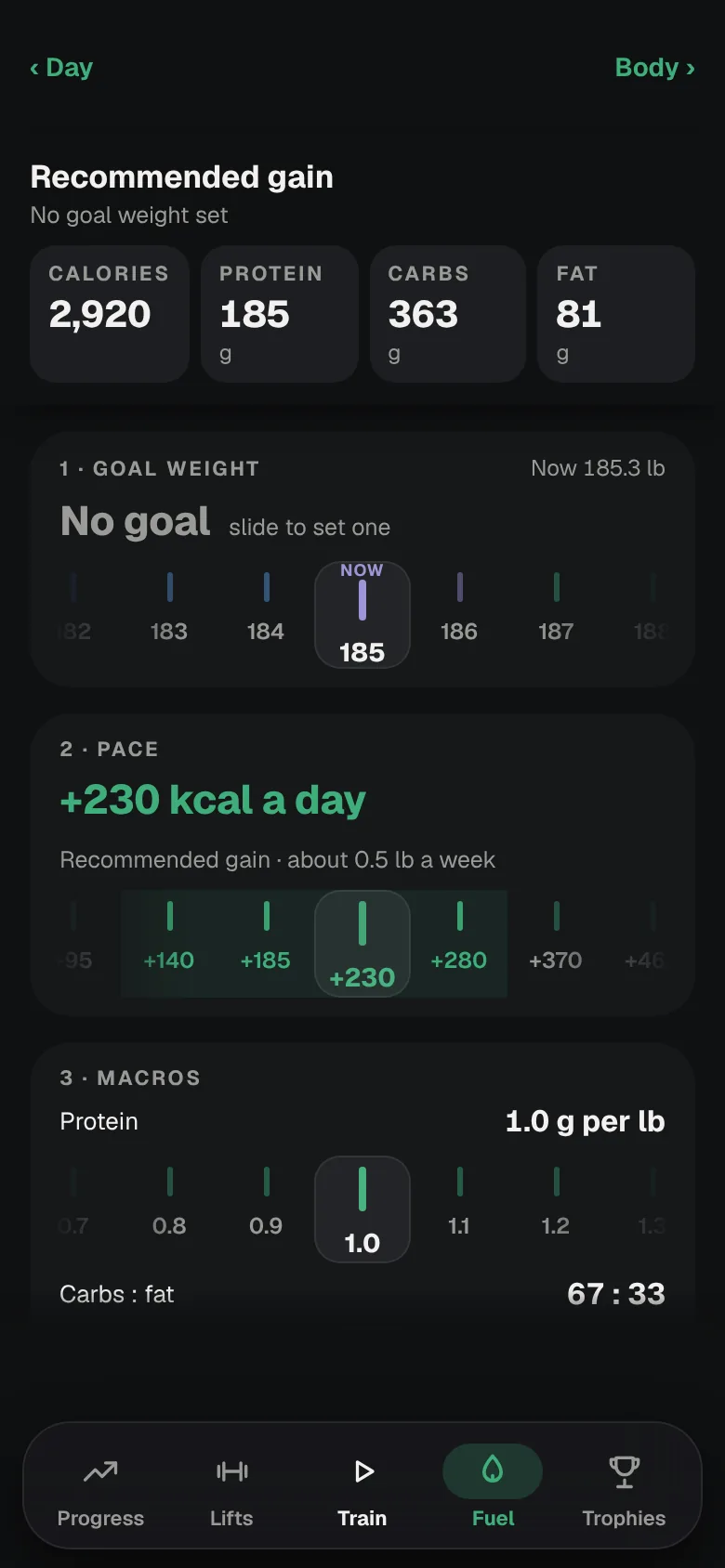
Meals sit on an hour-by-hour rail with what is left for the day on top: calories, protein, carbs and fat. Tap any hour to log in it. Copy or move a meal to any day. Your plan sets the targets, and they update as your expenditure is learned from your weigh-ins. The scale is at the top of every page.
Sample day.
Lifts
Every lift and muscle, ranked by how it changed.
Noise is how far a lift's estimated max normally moves from one session to the next when nothing has changed. Strength Pace measures it from your own log, lift by lift. Every change moves your Index, but a change is marked clear only when it's bigger than that lift's noise, and a record has to clear it too. A solid bar is clear of the noise. A faded one is still inside it. A muscle's bar is the change in the lifts that train it.
One lifter's real data, from the app's Lifts tab.
Where to focus
What needs you, and the next target.
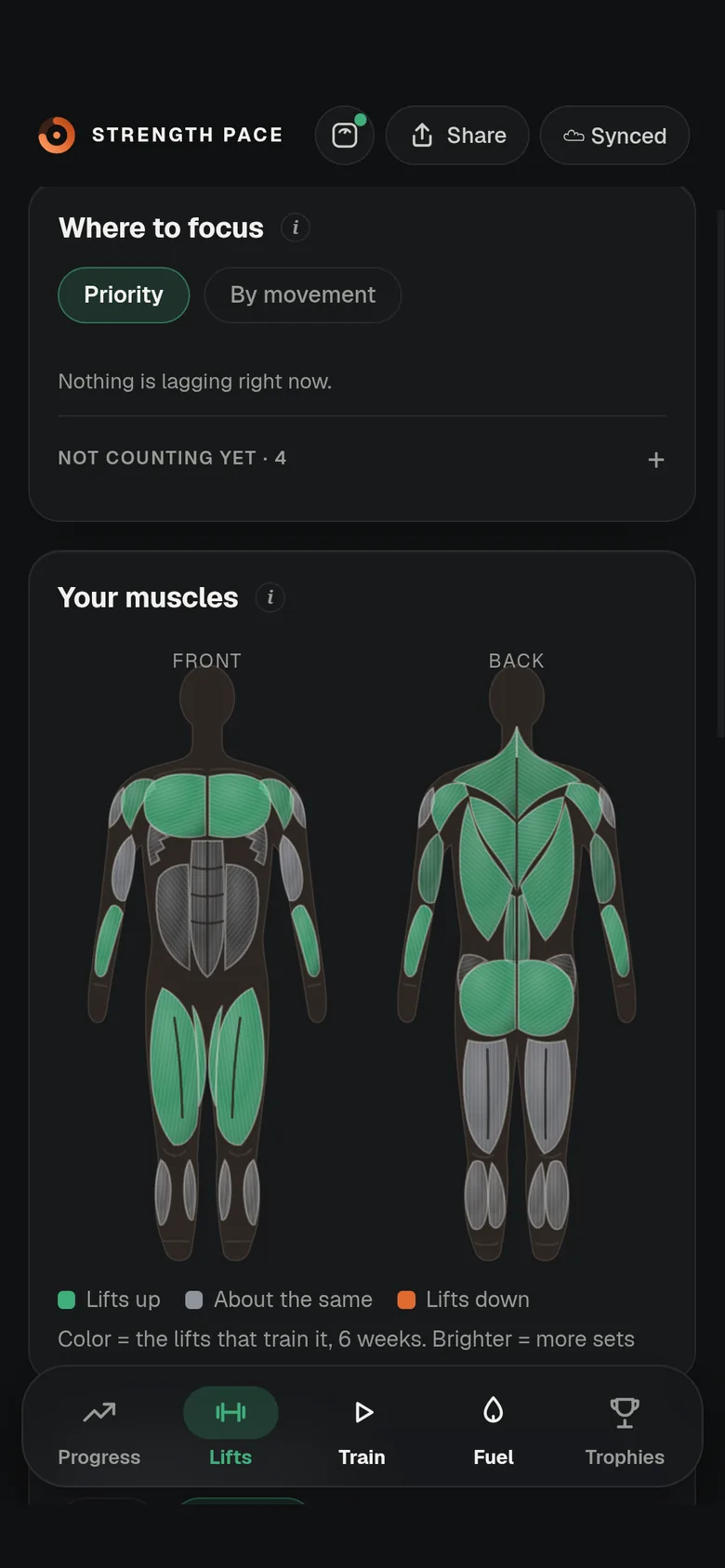
A lift is stalled when it has gone 3 sessions and at least 3 weeks without a new best, and its 6-week change is flat. Overdue means you haven't trained it lately. Coming back means it's rebuilding after a break. Each one gets its next target, and a muscle map shows where your sets go and how the lifts for each muscle are moving.
One lifter's real data, Nov 23, 2026.
Trophies
Earned against your own past self.
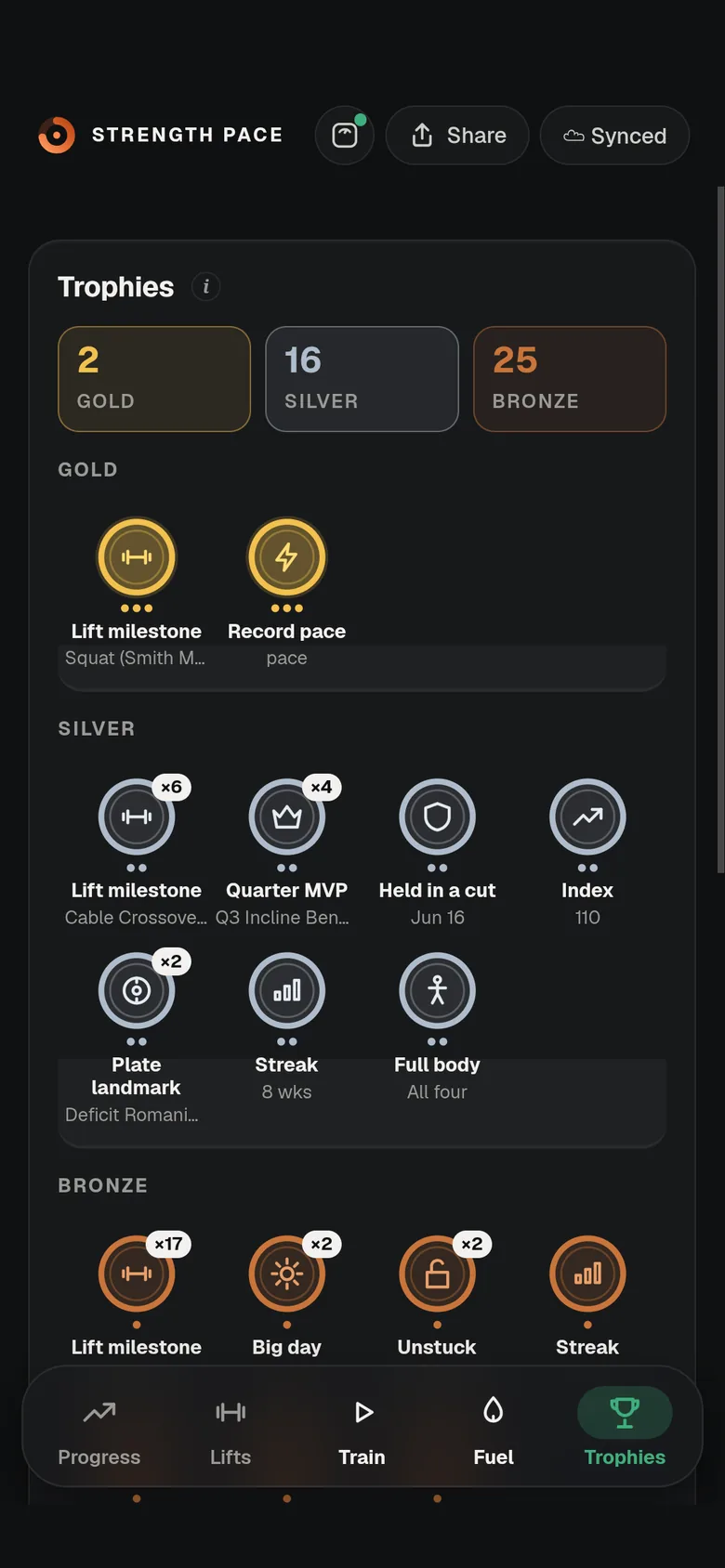
Trophies come for habits you control and for progress past your own noise. Bronze, silver and gold mark harder steps. A few of them:
- PR day New bests on 2 or more lifts in one workout.
- Plate landmark Your first working set at 135, 185, 225, 275 or 315 lb (60, 80, 100, 120 or 140 kg) on a bar lift.
- Lift milestone A lift up 10, 25 or 50% since it joined your Index.
- Streak 3 or more workouts a week, 4 weeks running.
- Full body All four movements in your Index: squat, hinge, push and pull.
- Full-body streak Squat, hinge, push and pull every week, 4 weeks running.
New or experienced
Different starting points. The same scoring.
New to lifting
Every set planned from day one
Build a routine for the days and time you have, and every set comes with its target, so you always know what to try next. The four movement rows fill in from your first session and show which movement to add next. Your Index opens once two movements each have a lift with 5 sessions, and your pace six weeks after your first workout.
Years in
Bring your history, get your score
Import from Strong, Hevy, MacroFactor, or a CSV with a date, exercise, weight and reps for each set. If your history has five sessions of one lift in each of two movements (two or more working sets each), your Index opens the day you import. The noise band marks which changes stand out from an ordinary good or bad day, and your phases sit next to your strength so you can compare them.
Get it
Put it on your phone. Log your first session.
It lands on your home screen and opens full screen, like any app. Nothing to download from a store, and no account needed to start.
Or scan with your phone's camera- Android: one tap in Chrome.
- iPhone: open it in Safari, tap Share, then Add to Home Screen.
Strength Pace is a web app, so there is no App Store or Play Store listing.
Early access. Built with the lifters who use it: tell us what's confusing and it gets fixed. Send feedback